

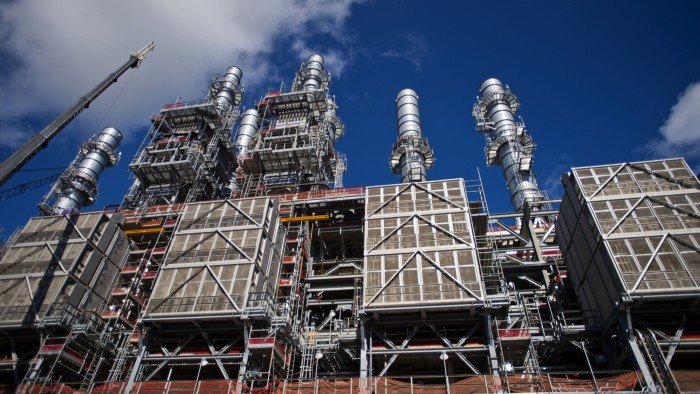
US liquefied natural gas terminals, including those operated by major producers Venture Global and Cheniere Energy, have all violated air pollution permits at least once over a period of five years, according to a new report by an environment watchdog, raising the issue of public health and environmental risks from the AI-fuelled industry boom.
The independent non-profit Environmental Integrity Project (EIP) found that all of the seven US LNG terminals fully operational at the end of 2024 had violated the Clean Air Act, which regulates air emissions. Five of the seven facilities also exceeded water pollution permits by dumping illegal levels of bacteria, zinc, copper, oil, grease and other contaminants into waterways.
The report comes as US LNG capacity has been rapidly increasing under the Trump administration, which has promised to rollback a key component of the Clean Air Act that regulates air pollution, though the change has not yet taken effect.
All seven of the terminals, located in Louisiana, Texas, Georgia and Maryland, emitted more than 18mn tons of greenhouse gases in 2023 and more than 15,000 tons of health-damaging air pollutants, according to the EIP.
Cheniere Energy’s Sabine Pass and Corpus Christi terminals in Louisiana and Texas respectively, as well as Venture Global’s Louisiana Calcasieu Pass facility, were the top emitters in 2023, releasing 6.9mn, 3.3mn, and 3.1mn tons of greenhouse gases. Both companies are pursuing expansion of facilities at those sites.
“Given the LNG industry’s poor compliance record, state and federal agencies should be slowing down and more carefully scrutinising new permit applications,” Jen Duggan, executive director of the Environmental Integrity Project, said.
“Fast-tracking approvals for LNG terminals puts the health of local communities, ecosystems, and the climate at risk.”
The Environmental Protection Agency administrator Lee Zeldin said in July that the agency would rescind the “endangerment finding”, which is the legal basis for the government’s ability to regulate greenhouse gas emissions over public health concerns under the Clean Air Act.
Meanwhile, the Trump administration has already approved three LNG terminals, with five more expected by the end of the year.
US companies have proposed building 33 additional LNG facilities over the next decade, including those identified in the report.
Venture Global plans to build two new LNG terminals in Louisiana, while Cheniere has proposed major expansions at its existing facilities.
Sempra Infrastructure, the majority owner of Cameron Parish LNG, one of the seven already operating in 2024, is now developing another export facility in Texas.
Venture Global said Calcasieu Pass has and continues to be in compliance with federal and state regulations and that the Louisiana Department of Environmental Quality concluded in March 2025 that the company is “willing and able” to achieve and maintain compliance with applicable federal state regulations.
“A deviation does not constitute a ‘violation’ as alleged [in the report] and occur across the industry during a project’s commissioning; Calcasieu Pass has been in full compliance with its annual air permit emission limits,” a Venture Global spokesperson said.
Sempra Infrastructure did not respond to requests for comment. Cheniere declined to comment.
The EIP calculated that if only 22 of the 33 proposed terminals were built, they could emit nearly 80mn tons of greenhouse gases and about 100,000 tons of air pollutants annually.
Methane released or leaked in production or distribution is one of the most potent greenhouse gases, as the molecule traps 80 times more heat than carbon dioxide over a 20-year period but has a shorter lifespan. Its suppression is regarded as one of the most efficient ways of tackling climate change.
Despite being one of the major greenhouse gas emitters in 2023, Cheniere is a member of the UN-led Oil and Gas Methane Partnership, a standardised reporting framework to monitor industry greenhouse gas emissions.
The Environmental Protection Agency and state regulators have issued 15 enforcement actions to LNG terminal operators that have resulted in a total of about $1mn in penalties, but the EIP warns that is only a small sum compared to the maximum amount that is allowed under the law.
Freeport LNG has received the most enforcement orders and the highest penalties, amounting to $669,604 over the past five years. The facility experienced an explosion in 2022 but the EIP reported that in the two years prior to the event, it had already received 16 violations and four enforcement orders from state regulators over violations including failing to prevent unauthorised emissions of nitrogen oxides and failure to properly operate flares. Freeport LNG declined to comment.
Climate Capital

Where climate change meets business, markets and politics. Explore the FT’s coverage here.
Are you curious about the FT’s environmental sustainability commitments? Find out more about our science-based targets here
This article has been amended to clarify Sempra Infrastructure is the majority owner of Cameron Pass LNG and to include a response from Venture Global