

This article is an on-site version of our Moral Money newsletter. Premium subscribers can sign up here to get the newsletter delivered twice a week. Standard subscribers can upgrade to Premium here, or explore all FT newsletters.
Visit our Moral Money hub for all the latest ESG news, opinion and analysis from around the FT
Welcome back.
Under the Trump administration, the Securities and Exchange Commission is on a mission to “Make IPOs Great Again” — that is, to usher in a wave of new listings that will reinvigorate the US stock market.
New SEC chair Paul Atkins reckons that a major factor deterring companies from going public has been the “politicisation of shareholder meetings [through] shareholder proposals focused on environmental and social issues”.
As US regulators and lawmakers move to crack down on such shareholder resolutions, there’s been rising political heat on the proxy advisory firms that issue recommendations to investors on how to use their votes.
Now Glass Lewis, one of the two firms that dominate that sector, has decided to take the radical step of scrapping its benchmark recommendations.
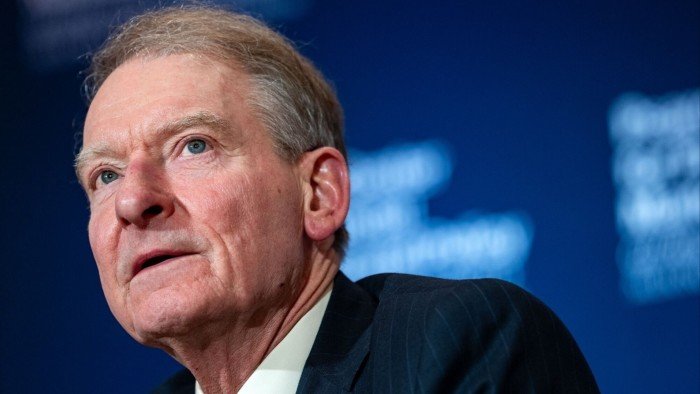
In an interview for today’s Moral Money, its chief executive Bob Mann explained the logic for the move — and suggested that the pressure on his company reflects much larger political dynamics around shareholder rights in the US.
Let us know your take at moralmoneyreply@ft.com.
Glass Lewis CEO: ‘I don’t think this stops with us’
“They should be gone and dead and done with,” JPMorgan chief executive Jamie Dimon told a conference earlier this year.
He was referring to Institutional Shareholder Services and Glass Lewis, the dominant proxy advisory firms used by institutional investors for shareholder vote decisions. Dimon’s broadside added to the public pressure on the two firms, which have faced fierce criticism from US Republicans for allegedly pushing progressive values.
Federal lawmakers have proposed legislation aimed at discouraging them from basing recommendations on sustainability-related issues. Texas attorney-general Ken Paxton last month announced an investigation into suspicions that the firms have worked to “advance radical political agendas”. The state has also passed a law forcing them to issue public self-criticisms if they consider environmental or social factors in their advice (implementation of the law is suspended as the companies fight it in court).
But even as they continue to reject their critics’ allegations, the two firms are taking steps to address them — or at least to tackle the “perception of influence”, as Glass Lewis put it in a statement on Wednesday.
The announcement marked a major change of strategy for the firm. From 2027, it will no longer provide a benchmark position (or “house view”) on voting decisions. Instead, it will offer clients four different “perspectives”, with differing approaches to governance and sustainability issues.
Chief executive Bob Mann told me that the move could reduce Glass Lewis’s exposure to the “real, meaningful regulatory risk associated with our business”.
But he also framed it as a response to the growing divergence between European and US investors on shareholder vote decisions, particularly in relation to environmental and social issues.
Last year, big European asset managers’ average rate of support for environmental and social shareholder proposals at listed companies was 81 per cent — up from 68 per cent in 2021, according to ShareAction research. Over the same period, the support rate among their US counterparts halved to less than 20 per cent.
“I think that the world is becoming fragmented, and that it’s much more difficult to have that, let’s say, single truth in this world,” Mann said. But rather than a worldwide fragmentation, he added, the divide is being driven by developments in a single country.
“I don’t think that, say, the Australians and the Europeans are separating their perspectives in an increasing fashion . . . I think the US is diverging increasingly rapidly from the rest of the world.”
Glass Lewis’s announcement came a week after a telling, if less radical, move by its rival ISS. The latter firm said it would launch a new offering of research on companies that will come “without vote recommendations or any policy view”, as a spokesman put it to me. Unlike Glass Lewis, ISS says it has no plans to scrap its benchmark recommendations.
Both firms have said that their moves will enable their investor clients to take more control of their own voting decisions. “It’s not my job to have a take on how material is climate risk for a particular company; that has to sit with [the client],” Mann said. “We want them to own their decision. We want it to align with their investment thesis. And we think that’s good for the market.”
Less healthy, to some eyes, is what looks like an erosion of investor rights by Donald Trump’s administration. The Securities and Exchange Commission has made a series of moves to crimp outside shareholders’ power and strengthen that of corporate management.
Last week, SEC chair Paul Atkins suggested the regulator would look favourably on corporate efforts to stop some environmental and social proposals going to a shareholder vote.
“The administration and its allies [are] trying to create a freer environment for companies to operate in, one where they feel less obligated and face less scrutiny,” Mann said. “I think that’s at the heart of what this is about, right? They think that shareholders exert too much influence, sometimes undue influence, and we are an intermediary for helping that influence be exerted.”
What this means for the US economy is a live question. Dimon, for example, believes that proxy advisers have contributed to increasingly difficult conditions for corporate managers that are “driving companies out of the public market”. The US currently has about 4,700 listed companies, down from a peak of about 7,800 in 2007, the SEC’s Atkins said last week.
But, wherever you stand on sustainability and shareholder rights, this week’s announcement from Glass Lewis sends an important signal about the direction of travel in the US market. As Mann put it: “I don’t think this stops with us. I don’t think we are really the thing.”
Smart reads
Missed opportunity Three decades into South Africa’s Black Economic Empowerment system, critics argue that its benefits have accrued disproportionately to a politically connected few.
Balancing priorities Restrictions on Chinese imports will push up the west’s wind energy costs, claimed an executive at Goldwind, one of China’s biggest turbine producers.
New reality JPMorgan’s new $1.5tn “security and resiliency initiative” amounts to “ESG with Maga characteristics”, writes Robert Armstrong.
Recommended newsletters for you
The Climate Graphic: Explained — Understanding the most important climate data of the week. Sign up here
The AI Shift — John Burn-Murdoch and Sarah O’Connor dive into how AI is transforming the world of work. Sign up here